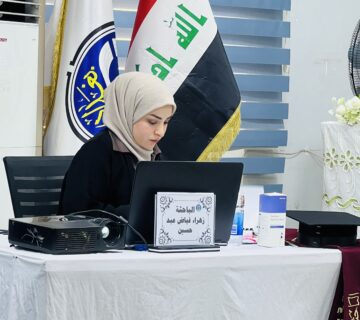

The College of Nursing at the University of Baghdad hosted the defense of a Doctoral dissertation in the Skills Lab by researcher Mahmoud Radhi Dawood Al-Kinani, titled (The Effect of Virtual Reality and Relaxation Technique on Fatigue, Burnout, and Satisfaction Among Intensive Care Unit Nurses: A Randomized Controlled Trial), supervised by Assist. Prof. Dr. Alaa Jawad Kadhim.
The study primarily aimed to evaluate the effectiveness of Virtual Reality (VR) immersive technology in alleviating fatigue and burnout among critical care nursing staff, assess the clinical impact of Jacobson’s Progressive Muscle Relaxation (JPMR) on these psychological parameters, investigate the combined therapeutic effect of VR and JPMR, and measure overall nurse satisfaction with these interventions within the clinical intensive care environment.
The findings demonstrated that both Virtual Reality and Jacobson’s Progressive Muscle Relaxation—whether implemented independently or in combination—effectively reduced levels of fatigue and burnout among ICU nurses, alongside yielding high rates of participant satisfaction. Furthermore, statistical analysis revealed no significant therapeutic superiority of one intervention over the other, nor did the combined modality demonstrate additional statistical benefit, confirming the flexible, practical utility of either intervention according to institutional workflow needs.
Based on the research outcomes, the study recommended integrating structured, short relaxation sessions utilizing VR or Jacobson’s muscle relaxation into the daily break schedules of ICU healthcare personnel, embedding evidence-based stress mitigation and coping strategies into continuous professional development programs, and executing future multicenter longitudinal studies across broader sample cohorts to evaluate the long-term sustainability of these digital interventions across varied shift schedules and occupational workloads.
Following an in-depth scientific discussion, the dissertation was awarded an “Excellence” (Distinction) grade.
The outcomes of this research align closely with the Sustainable Development Goals (SDGs) advanced by the College of Nursing at the University of Baghdad—particularly Goal 3 (Good Health and Well-being), Goal 8 (Decent Work and Economic Growth), and Goal 9 (Industry, Innovation, and Infrastructure)—by leveraging digital solutions and technological innovations to support the psychological and physical well-being of nursing personnel, cultivating healthy occupational environments, and advancing clinical care quality in critical care settings.