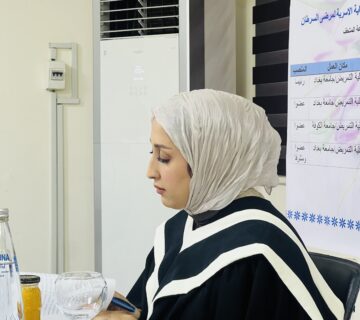

The College of Nursing at the University of Baghdad discussed the doctoral dissertation titled “The Effectiveness of an Intervention Based on the Health Belief Model in Preventing Falls Among the Elderly: A Controlled Community-Based Trial” by student Zahra Hassan Hanoun, under the supervision of Professor Dr. Wasana Juma Muhammad, in the college’s main auditorium.
The thesis primarily aimed to determine the effectiveness of an intervention based on the Health Belief Model in preventing falls among the elderly, as well as to determine the relationship between the demographic and health characteristics of older adults—including age, body mass index, socioeconomic status, health status, and behavioral information—and the model’s dimensions: perceived fall susceptibility, perceived risk, perceived benefits, perceived barriers, action motivators, health motivation, and self-efficacy.
The study results showed a positive effect and statistically significant differences following the implementation of the intervention program, confirming the hypothesis that an intervention program based on the expanded Health Belief Model improves older adults’ health beliefs and their adherence to preventive measures to reduce falls.
The study recommended that this research be replicated to include geographically, demographically, and clinically diverse subgroups across all Iraqi governorates, with the aim of developing a comprehensive nationwide map of fall risks, and to activate the role of community health nurses in collaborating with the Ministry of Health, the Ministry of Higher Education and Scientific Research, the Ministry of Labor and Social Affairs, and nongovernmental organizations to launch health campaigns aimed at raising public awareness about the consequences of falls among older adults, in addition to establishing structured psychological and social support programs based on periodic visits to older adults residing in care facilities in Baghdad and the rest of Iraq’s governorates to promote their psychological well-being. Following an extensive academic discussion, the researcher’s efforts were rewarded with a “very good” grade.
This research fulfills academic institutions’ commitment to achieving the Sustainable Development Goals, particularly Goal 3 on good health and well-being, as promoting preventive health care and comprehensive care for the elderly contributes to building a healthy and sustainable social environment that ensures quality of life for this demographic.