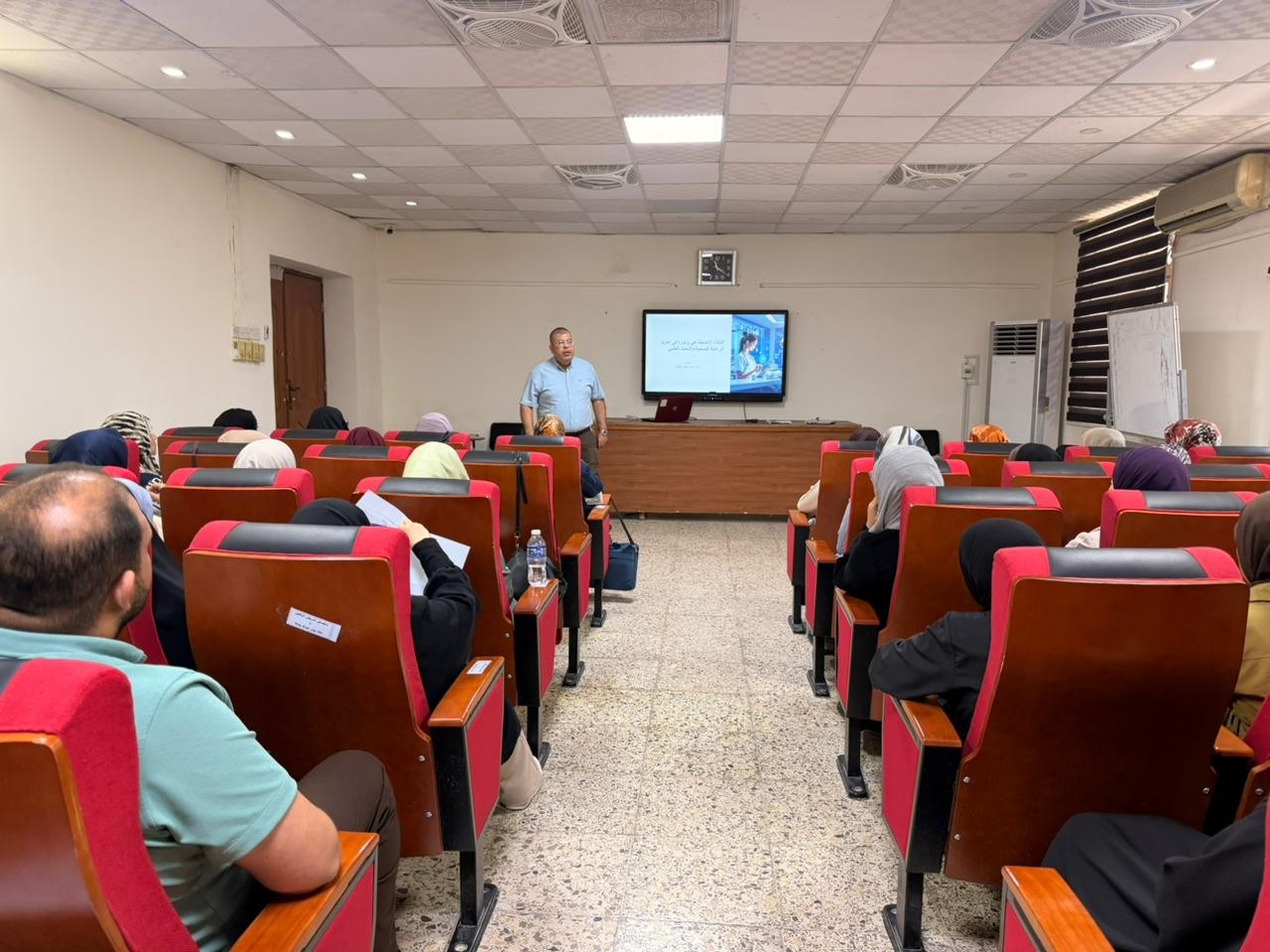
The Continuing Education Unit at the College of Nursing, University of Baghdad, organized a specialized workshop titled “Artificial Intelligence and Its Role in Enhancing Healthcare and Scientific Research.” The workshop was presented by Assistant Professor Dr. Zaid Wahid Ajel and attended by a group of doctoral students in the Museum Hall of the college building. The workshop aimed to introduce participants to the concept of artificial intelligence in the healthcare context and to understand its pivotal role in simulating human thinking to support nursing decision-making and accelerate the pace of scientific research through the use of advanced tools for literature review, such as Eliset, Consensus, and Semantic Scholar, as well as improving diagnostic and clinical accuracy through real-time analysis of patient data and reduce the administrative burden on healthcare staff.
The workshop also focused on empowering doctoral students to use rigorous academic writing tools, organize scientific references, and apply risk prediction techniques, electronic record analysis, and virtual care, while emphasizing strict adherence to ethical use, data privacy protection, and the avoidance of algorithmic bias to ensure scientific integrity in research outputs.
The workshop concluded with a set of key recommendations, the most notable of which was the need to compile a comprehensive list of AI tools suitable for each research or clinical task and to conduct periodic practical applications for analyzing nursing studies and extracting data from them, in addition to formulating personal plans to integrate these technologies into the preparation of nursing research while implementing to detect biases and digital illusions before adopting the results.
This scientific event is part of a series of activities organized by the College’s Continuing Education Unit to enhance researchers’ skills and develop their competencies, thereby contributing to the achievement of the Sustainable Development Goals, particularly Goal 4, which aims to ensure quality, equitable, and inclusive education for all.