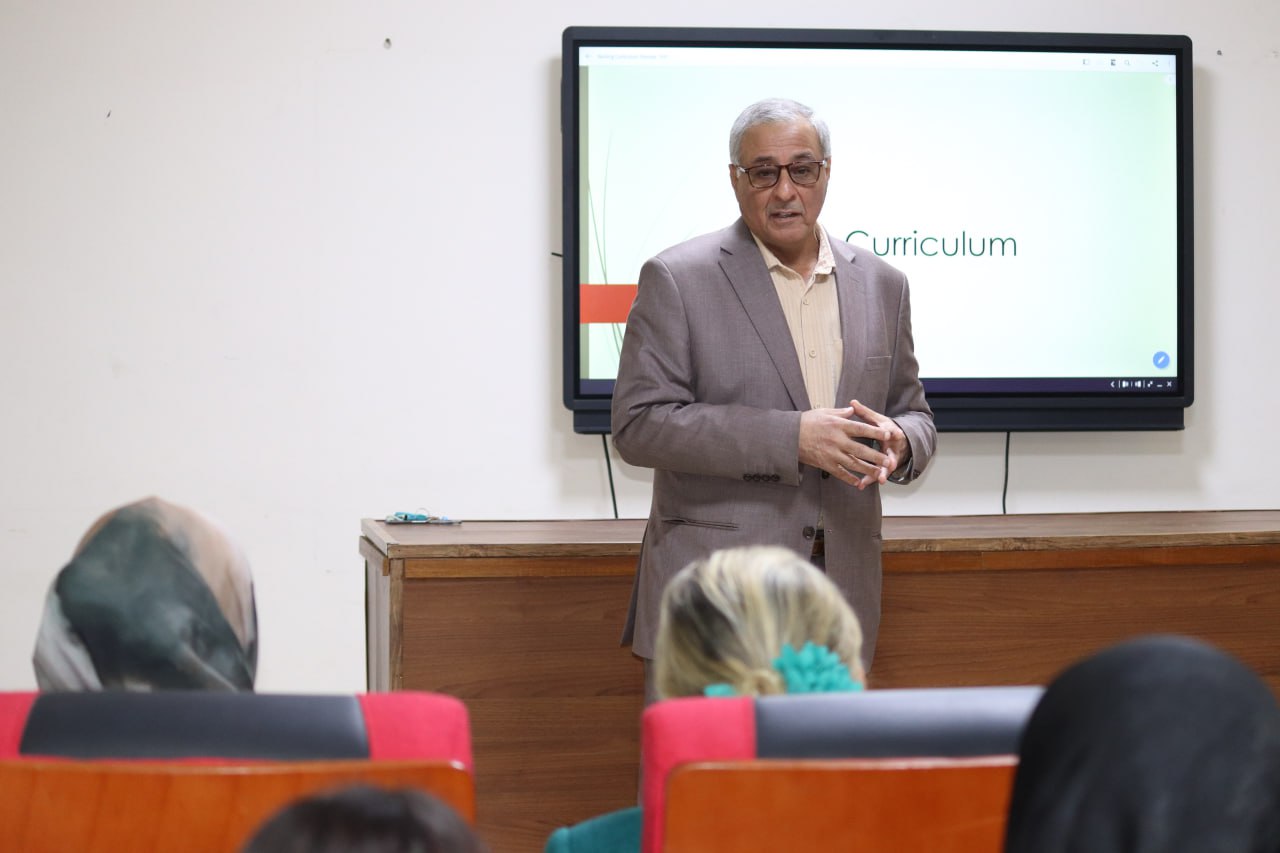
The college of Nursing organized a specialized scientific workshop entitled “Updating Nursing Curricula,” presented by Professor Azra Hussein Shawq and Assistant Professor Dr. Muhammad Jawad Kazim, with the active participation of academics and specialists in educational development. The workshop aimed to highlight the utmost importance of reviewing and developing nursing curricula in line with the rapid advances in the global healthcare sector, and to work on a radical shift from traditional teaching models that focus on content delivery to modern curricula based on professional competence and educational outcomes whose impact can be clearly measured in the field.
The workshop sessions delved into mechanisms for aligning these curricula with rigorous academic accreditation standards and changing labor market requirements, ensuring that graduates’ skills are honed in clinical aspects, advanced critical thinking, and the ability to make critical decisions in complex work environments. Researchers also reviewed innovative design models such as concept-based and competency-based curricula, discussing practical steps to update teaching strategies and assessment systems to ensure full integration between theoretical knowledge and real-world application.
The event witnessed lively interaction through scientific interventions in which attendees exchanged views on current challenges and ways to continuously improve the quality of nursing education. In conclusion, the speakers emphasized that these efforts directly contribute to the achievement of sustainable development goals, particularly Goal 3 on good health and well-being, by preparing highly qualified nursing cadres capable of strengthening the national health system, ensuring the sustainability of medical services, and improving institutional performance to meet the needs of current and future generations in the face of public health crises. The College of Nursing explores mechanisms for updating educational curricula to enhance the efficiency of health outcomes
The College of Nursing organized a specialized scientific workshop entitled “Updating Nursing Curricula,” presented by Professor Azra Hussein Shawq and Assistant Professor Dr. Muhammad Jawad Kazim, with the active participation of academics and specialists in educational development. The workshop aimed to highlight the utmost importance of reviewing and developing nursing curricula in line with the rapid advances in the global healthcare sector, and to work on a radical shift from traditional teaching models that focus on content delivery to modern curricula based on professional competence and educational outcomes that can be clearly measured in the field.
The workshop sessions delved into the mechanisms for aligning these curricula with rigorous academic accreditation standards and changing labor market requirements, ensuring that graduates’ skills in clinical aspects, advanced critical thinking, and the ability to make critical decisions in complex work environments are honed. Researchers also reviewed innovative design models such as concept-based and competency-based curricula, discussing practical steps to update teaching strategies and assessment systems to ensure full integration between theoretical knowledge and real-world application.
The event witnessed lively interaction through scientific presentations in which attendees exchanged views on current challenges and ways to continuously improve the quality of nursing education. In conclusion, the speakers emphasized that these efforts directly contribute to the achievement of sustainable development goals, particularly Goal 3 on good health and well-being, by preparing highly qualified nursing cadres capable of strengthening the national health system, ensuring the sustainability of medical services, and raising institutional performance efficiency to meet the needs of current and future generations in the face of public health crises.


