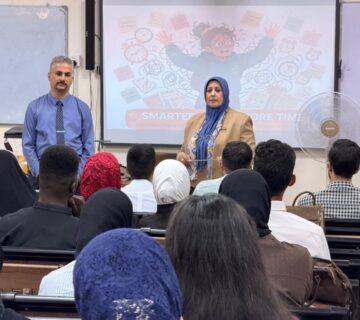

The Psychological and Educational Counseling Unit, in collaboration with the University Psychological Counseling Unit at the College of Nursing, University of Baghdad, held a specialized guidance and training workshop for fourth-year students who are about to graduate and begin working at teaching hospitals, under the slogan: “You are not just tomorrow’s graduates… You are the future leaders of the hospital wards.” The workshop featured presentations by Professor Raja Ibrahim Abdul, Assistant Professor Wafa Abdul Ali Hattab, and Mr. Mustafa Ali Hussein, and was attended by a large group of fourth-year students preparing for independent professional practice.
The workshop aimed to enable fourth-year students to make a smooth and professional transition from the stage of academic supervision to that of direct accountability and independent nursing practice at the patient’s bedside, and to enhance their personal and professional competence to ensure their ability to make critical clinical decisions when dealing with both stable and critical cases. It also aimed to provide psychological and counseling support to help students manage the shock of real-world clinical settings and equip them with coping mechanisms, independence, and leadership skills in teaching hospitals, as well as to help them overcome the fear of accountability and hesitation when first dealing with critical cases in intensive care and emergency units.
The workshop addressed several key topics, beginning with redefining the concept of self-efficacy—shifting from demonstrating memorization on exams to believing in one’s ability to save a patient’s life—and bridging the gap between conducting nursing simulations under faculty supervision and making independent decisions and taking action during clinical shifts, while identifying indicators of psychological readiness, such as stress management and evidence-based nursing initiative. The workshop also reviewed managing “reality shock” in the first months after graduation according to the modified Kramer model, presenting preventive strategies based on explicit psychological preparation for workplace realities and avoiding overly idealistic expectations.
The workshop concluded with a recommendation and a guiding summary in which the lecturers emphasized that self-efficacy and leadership are not merely texts to be memorized, but rather a behavioral path forged through each work shift with competence and steadfastness, along with a call for graduates to trust the deep academic foundation they have built at their college, thereby contributing to the advancement of health and education and achieving the Sustainable Development Goals (Goal 3: Good Health and Well-being, and Goal 4: Quality Education)