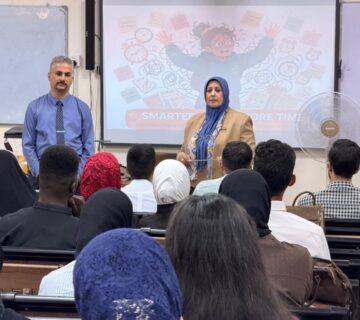

The Continuing Education Unit at the College of Nursing, University of Baghdad, in collaboration with the university’s Civil Defense Division, organized a specialized workshop titled “First Aid,” which was held in the Al-Idrisi Hall at the College of Sciences, University of Baghdad. The workshop was led by Professor Hakima Shaker Hassan, Assistant Professor Ali Hussein Alak, and Assistant Professor Haider Muhammad Majid, and was attended by staff from the university’s Civil Defense units, as well as faculty members and staff of the College of Sciences.
The workshop aimed to familiarize participants with the principles of first aid and equip them with the basic skills to handle emergency situations, as first aid is the initial assistance provided by an individual—whether a specialist or a layperson—to a person facing a life-threatening situation or experiencing a disability or severe pain resulting from a sudden illness or accident, with the goal of preserving their life and preventing their condition from deteriorating until they are transported to a hospital or a certified medical team arrives.
The workshop addressed the most critical medical emergencies that students and staff might encounter on campus and the correct methods for handling them in the field. It also covered the types and classifications of bleeding and wounds, along with first aid techniques for each, as well as how to handle cases of loss of consciousness, fractures, and burns. The workshop featured hands-on practice of first aid skills, which allowed participants to build confidence in their ability to respond quickly and effectively in the event of an accident.
The workshop concluded with a recommendation to promote a culture of first aid among university staff and students, to hold periodic training sessions in coordination with Civil Defense, and to provide first-aid kits in all university facilities to enhance safety and emergency response within the university environment, thereby achieving the Sustainable Development Goals (Goal 3: Good Health and Well-being, and Goal 4: Quality Education).