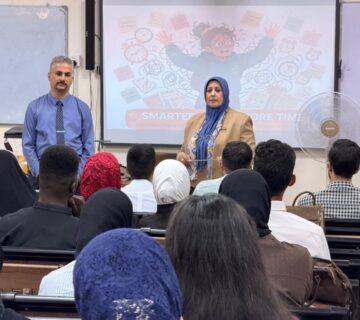

The main auditorium at the College of Nursing at the University of Baghdad hosted a defense of the master’s thesis titled “University Students’ Readiness to Maintain Their Circadian Rhythm: The Theory of Change Model as a Theoretical Framework” by student Agadir Abdul Rashid, under the supervision of Dr. Muhammad Baqir Habib.
The study aimed to determine the extent to which university students are prepared to maintain their biological clock, as well as to determine whether experiential and behavioral change processes, the pros and cons of maintaining the biological clock, self-confidence, and the temptation to disrupt it; can predict the extent of this readiness, as well as to identify the direct and indirect effects of these psychological and behavioral factors on students’ readiness levels.
The thesis findings concluded that students possess varying levels of readiness and willingness to maintain the stability of their biological clock, with psychological and behavioral factors (such as self-confidence and the extent of surrounding temptations and distractions) playing a significant role and serving as a strong predictor of their ability to adhere to it; The results also revealed statistically significant differences in levels of awareness and the ability to regulate the circadian rhythm among different student groups based on variables such as gender, academic level, and socioeconomic status. The student received a grade of “Very Good (High)” for her thesis.
The study recommended the need to design and implement guidance and awareness programs within academic institutions to educate students on the importance of a stable circadian rhythm and train them in behavioral strategies that enhance their readiness for a healthy lifestyle, and to develop preventive and therapeutic support programs to help them cope with temptations and distractions that disrupt their sleep patterns and to boost their self-confidence, in addition to taking individual differences (gender, academic level, and socioeconomic status) into account when providing this support to ensure its effectiveness.
This scientific output is consistent with the College of Nursing’s commitment to achieving the United Nations Sustainable Development Goals, particularly Goal 3 on “Good Health and Well-being,” by highlighting the mental and physical health of university students and providing evidence-based behavioral solutions to improve sleep quality and stabilize daily life, thereby positively impacting the academic performance and overall well-being of the student community.