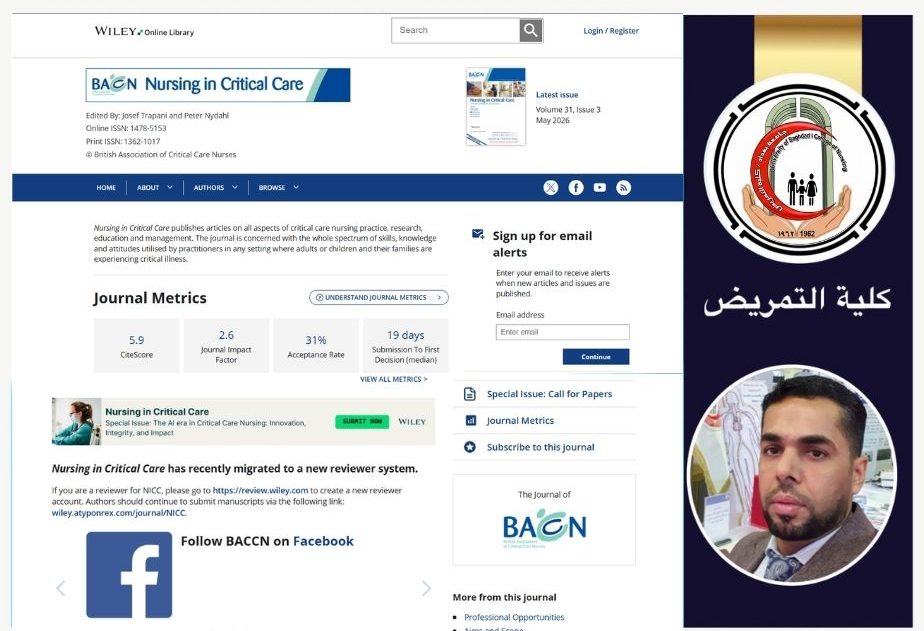
Assistant Professor Dr. Alaa Jawad Kazem, a faculty member at the College of Nursing at the University of Baghdad, published a unique scientific research paper in the journal “Nursing in Critical Care,” published by the international publisher “Wiley” in the United Kingdom, and ranked in the first quartile (Q1) in the Scopus and Clarivate databases. The study, titled “The Care Experience in the Intensive Care Unit Following Traumatic Brain Injury: An Interpretive Phenomenological Study of Nurses and Families,” the nature of the quality of care provided to patients with traumatic brain injuries. The researcher’s objective was to uncover, describe, and interpret the phenomena underlying this complex process, given that the experiences of nurses and patients’ families had not been sufficiently studied previously despite their critical role in patient recovery and overall outcomes
In designing the study, the researcher employed a phenomenological interpretive approach based on Van Manen’s framework, with the participation of twenty-eight nurses from the intensive care unit and family members of patients. Data were collected through field observations and semi-structured in-depth interviews and analyzed concurrently with collection using the “MAXQDA” software. The study’s findings indicate that the quality of care provided to these patients is a dynamic, multifaceted, and context-dependent process, leading to the identification of a key theme: “High-quality ethical care in a challenging context,” within the categories of care management challenges, ethical care, and satisfaction with care. This confirms that adopting an ethical care approach centered on the patient and their family can significantly improve the quality of care and satisfaction with it
This research paper offers in-depth analytical insights into the quality of care by exploring the perspectives of families and nurses, and identifies the key factors influencing the quality of nursing care in intensive care units, while highlighting the need for nurses to balance patient care with the needs of their families. In this context, this scientific achievement contributes to supporting the Sustainable Development Goals, particularly Goal 3 on good health and well-being, by providing scientific solutions aimed at improving the quality of health services provided to critically ill patients. This enhances the efficiency of nursing systems and ensures the sustainability of comprehensive, humane care that advances society both health-wise and scientifically.


