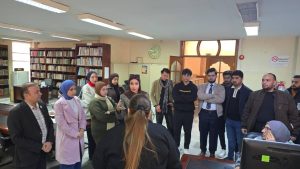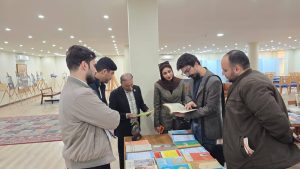

In celebration of World Arabic Language Day, the Training, Employment and Follow-up Unit at the College of Nursing at the University of Baghdad organized a scientific and cultural visit for third-year students to the Iraqi Library and Archives, under the supervision of Professor Dr. Houra Hussein Ghaffal and teacher Dr. Safad Riad Issam. This visit was organized in cooperation with the Cultural Development Department at the Ministry of Culture to emphasize the close connection between medical sciences and cultural identity. Students toured the library to view rare books and manuscripts that highlight the heritage of the Arabic language and its contributions to science and human civilization.
During the tour, the student delegation listened to a detailed explanation of the scientific methods used to preserve historical documents written in Arabic, and the mechanisms for restoring ancient manuscripts that represent an authentic part of Arab and Islamic heritage. The tour also included a special visit to the “Generations Library Section,” which deals with cultural and entertainment periodicals and magazines for different age groups, and aims to highlight the cultural identity of the country, as well as to learn about the training courses offered by the section in Arabic calligraphy and drawing.
The supervisors emphasized that the timing of the visit was chosen to reinforce the students’ pride in their mother tongue and to remind them that the Arabic language was and still is a vessel for science and knowledge. They pointed out the importance of general culture in refining the personality of university nurses and connecting them to their cultural roots, so that they are able to communicate effectively and provide comprehensive nursing services to individuals, families, and society in a refined, humane manner based on their cultural heritage.
) This initiative is at the heart of achieving the Sustainable Development Goals, specifically Goal 11 (Sustainable Cities and Communities) through the target (which states “Strengthen efforts to protect and preserve the world’s cultural and natural heritage”), and Goal 4 (Quality Education) by broadening students’ cultural and intellectual horizons beyond specialized curricula, as well as Goal 17 (Partnerships for the Goals), which is embodied in the fruitful cooperation between the university and the Ministry of Culture.