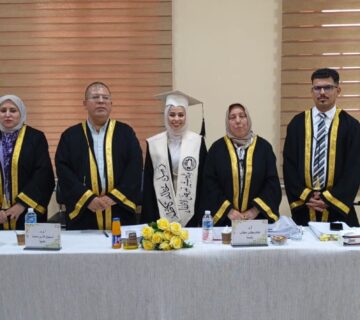

The College of Nursing examined the master’s thesis titled: “The Effect of Premature Infant Oral Motor Intervention Versus Pacifier Use on the Transition to Oral Feeding in Preterm Infants: A Randomized Controlled Trial,” submitted by the graduate student Laith Abdul-Kareem Hani, under the supervision of Assistant Professor Dr. Zaid Waheed Ajil, held in the Continuing Education Hall.
The study aimed to evaluate and compare the effectiveness of the Premature Infant Oral Motor Intervention (PIOMI) versus pacifier-supported non-nutritive sucking in facilitating a safe and complete transition to independent oral feeding. It also evaluated differences between the two modalities regarding the time to achieve full oral feeding, duration of hospital stay, weight gain trajectories, and early feeding skills development, while examining the influence of demographic and clinical variables on these outcomes.
The findings revealed that the PIOMI protocol was superior to pacifier use in significantly shortening the time required to attain full oral feeding, reducing the overall hospital stay, and promoting greater weight gain. Both interventions exhibited comparable efficacy in advancing early feeding competency and markedly outperformed routine standard care. Furthermore, favorable clinical outcomes were significantly associated with primary biological maturity indicators—specifically gestational age and birth weight—while remaining unaffected by infant gender, delivery mode, or respiratory distress.
Following an in-depth scientific defense, the thesis was approved, and the researcher was awarded a Master’s degree with an Excellence rating.
This study aligns directly with the Sustainable Development Goals, particularly Goal 3 (Good Health and Well-being) by advancing neonatal specialized care, reducing complications among premature infants, and enhancing survival rates; Goal 4 (Quality Education) by enriching specialized nursing disciplines with rigorous, evidence-based clinical research; and Goal 12 (Responsible Consumption and Production) by optimizing healthcare resource utilization and curtailing extended hospitalization in neonatal intensive care units.